difficulty owning and expressing your reality?
Did you know that you can own and express your own reality?
Maybe this seems ridiculously obvious, but for me and so many of the clients I've worked with, it can be a challenge in our closer relationships.
Did you know that you can own and express your own reality?
Maybe this seems ridiculously obvious, but for me and so many of the clients I've worked with, it can be a challenge in our closer relationships.
I've been studying Pia Mellody's model for codependence, and she says that one of the five core symptoms of codependence is difficulty owning and expressing our reality.
An important part of codependence recovery is learning that we can own our reality...and let other people own theirs too!
Wait, what?!
My kids can have their own wildly different thoughts about something and I can have mine!? (By the way, this doesn't mean we aren't accountable for the impact our reality might have on others.)
I've suffered from a lot of gaslighting, which makes it hard to trust my own reality.
And I often used to confuse agreement for intimacy.
Together, this made it difficult for me to realize that I even had my own distinct reality (and that others do, too), let alone claim it and express it as mine.
When we don't own our reality, it's hard to show up fully and be fully know—we're like fuzzy blobs.
And it's hard to take responsibility for ourselves when we don't know where we end and others begin.
So.
Owning and expressing our reality.
If you struggle with people-pleasing, fawning, or not trusting yourself, baby steps.
Try noticing your own reality—your thoughts, feelings, body sensations, behaviors.
Try noticing when your reality is different from a friend or loved one.
And then try expressing it, and no need to argue or explain. Just a Huh, I feel/think/act differently about that is a great place to start.
What do you think? I wanna hear about your reality!
With care,
Brianna
You are not a problem to be solved
I recently did an archetypal astrology session with the amazing Karen Hawkwood, and I can't stop thinking about something she told me.
I don't know much about astrology, but according to my chart (and this lines up with my lived experience), she said I have a lot of push/pull within me.
I recently did an archetypal astrology session with the amazing Karen Hawkwood, and I can't stop thinking about something she told me.
I don't know much about astrology, but according to my chart (and this lines up with my lived experience), she said I have a lot of push/pull within me.
And then she told me that this push/pull and the complexities and different parts in me do not need to be resolved. She said I am not a problem to be fixed!
As soon as she said this I felt my stomach expand and my shoulders relax.
I've studied self-compassionate work for years, but as a life-long fixer and recovering perfectionist, I tend to forget. I need to be reminded.
And somehow knowing that even my astrology chart had this message for me made it land in a new way. Ha!
If you're also one of those people who experience a lot of complicated parts inside you or a lot of push/pull internally, I see you. And if you struggle with perfectionism or always "fixing," I see you, too.
You are not a problem to be solved.
With care,
Brianna
P.S. By the way, all of this healing and learning is not about perpetual self-improvement. It's about taking conscious responsibility for my life (and my wounds) so that I can grow up and become a nourishing, stabilizing presence in the world. If you wanna do this kind of growing up, too, life coaching can help—sign up for a session!
Photo by Mark Stosberg via unspalsh
Are you coming? Out into the light?
"Are you coming? Out into the light? You who aren’t stone, but flesh? You who aren’t dead, but alive?"
"Are you coming? Out into the light? You who aren’t stone, but flesh? You who aren’t dead, but alive?"
Ah, I love these lines from the short story "Passages" by Elena Penga and I needed to read them again today. And I wondered if they speak to you, too?
Just in case we needed to know that others are also haunted by impatience with this life (are you coming!?).
Just in case we needed to know that others are standing a few steps ahead and holding the door open...are you coming?
Just in case we had forgotten our aliveness and had turned to stone (it's so easy to forget).
Just in case we needed to remember that there are questions like these, that we have choices.
Are you coming?
Out into the light?
You who aren’t stone, but flesh?
You who aren’t dead, but alive?
Gratefully, in this moment, my answer is yes. What about you? Are any of these questions speaking to you today?
I'm so glad you're here,
Brianna
P.S. If you want support around remembering your aliveness, around discovering choices, I’m here.

inner conflict + your younger self
How do you know if your younger self needs some attention?
I've noticed it often looks like inner conflict, feeling divided, or self-sabotaging. The desire to make amends to our younger self can also arise from a place of curiosity or compassion, of wanting to "check in" on those younger parts.
How do you know if your younger self needs some attention?
I've noticed it often looks like inner conflict, feeling divided, or self-sabotaging. The desire to make amends to our younger self can also arise from a place of curiosity or compassion, of wanting to "check in" on those younger parts.
Either way, you can't go wrong in bringing more attention to your younger self because this allows blocked or stagnant energy to flow and it allows for more awareness. Instead of just throwing up your hands over the inner conflict or reacting with old, stale patterns, you can begin to consciously shift things.
For me, this process has really changed my inner world—how I approach myself and talk to myself. I used to have so much hostility toward myself, and now I can usually access genuine friendliness. And of course, this can't help but change my outer world. It's a ripple effect.
If you're feeling stuck or feeling a lot of inner conflict (why do I keep doing that thing I don't want to do?!), try checking in with your younger self. Dig up a photo of yourself as a kid and put it by your bed or your sink or your front door. This is an act of love. Take off your solutions hat and really listen. You might be surprised with what you hear.
With care,
Brianna

I wanted to know but didn't want to ask
In my editing work I'm often helping my clients to clarify—their story or a chapter or a paragraph. But what if we can't?
In my editing work I'm often helping my clients to clarify—their story or a chapter or a paragraph.
But what if we can't?
The mythologist Martin Shaw talks about the authenticity of incompleteness, how this is part of what it means to be human, and I feel the truth of this deep down.
Honestly, this is a friendly debate I've been having with myself for years. Sometimes I revel in accepting the incompleteness of being human (and its bedfellow bewilderment) and other times I am passionately seeking coherence and clarity...a version of completeness.
I think it's a spectrum I move along depending on how confusing life is feeling.
And I am in awe of writers like Fanny Howe, who fully embrace the bewilderment. Here's the opening line in her collection of essays Meditations on a Wedding Dress: “What I’ve been thinking about, lately, is bewilderment as a way of entering the day as much as the work. Bewilderment as a poetics and a politics.”
Ms. Howe goes on to write: “There is a Muslim prayer that says, ‘Lord, increase my bewilderment,’ and this prayer belongs both to me and to the strange Whoever who goes under the name of ‘I’ in my poems—and under multiple names in my fiction—where error, errancy, and bewilderment are the main forces that signal a story.”
I read these words from Fanny Howe some years ago when life was feeling especially confusing, and her idea of bewilderment as a way of living and writing actually rattled/perplexed me so much that I wrote to her (I did a deep-dive search on the internet and found an old email address). What about the importance of coherence? I asked. She kindly wrote me back, but, fittingly, she didn't answer my question. Ha!
Anyway, today, I'm thinking about what it means to let go of clarifying, to let go even of clarifying this internal debate. This is the next step for my bewildered, incomplete, looking-for-clarity self.
With care,
Brianna
p.s. And an essay on Fanny Howe's poetry of bewilderment.

rituals and feast days
I love the work of artist and mystic Meinrad Craighead, and I was feeling a kind of cosmic nudge to honor her life in some way. I decided to celebrate a "feast day" for her, and I picked the day of her death, which was April 8th (she died in 2019).
I love the work of artist and mystic Meinrad Craighead, and I was feeling a kind of cosmic nudge to honor her life in some way.
I decided to celebrate a "feast day" for her, and I picked the day of her death, which was April 8th (she died in 2019).
So, I made a little altar with her art books, a photo of her, a candle, and some flowers. I told my kids about her, and all week long I've been smiling at her photo.
She was a woman who trusted herself so deeply, and, for me, her life is like a soul expander of what's possible. I feel a connection to her, even beyond death (more about the breadcrumb trail that led me to Meinrad here).
I grew up with a religion that didn't value trusting your own experience with/of the divine. So the freedom to find and honor what feels sacred in life and follow the cosmic nudges has been an essential part of my healing.
Where have you found your saints or guides or teachers? Would you like to celebrate their feast day? (It's traditionally the day of their death, but you could also celebrate the day you discovered their work, or their birthday, etc.)
With care,
Brianna
p.s. Want help following a cosmic nudge or dreaming up a ritual or feast day? I offer planning sessions here.

struggles
So many of us feel as if we should be struggling less. We think… But I am in recovery! Or I have therapeutic tools and know better! Or I have a spiritual or mindfulness practice! Or I've read all the books! Therefore, I should be happier and "handling things."
So many of us feel as if we should be struggling less. I hear my coaching clients talk about this, and I've so been there too!
We think....
But I am in recovery! Or I have therapeutic tools and know better! Or I have a spiritual or mindfulness practice! Or I've read all the books! Therefore, I should be happier and "handling things."
I've definitely fallen into this trap, quickly followed by thinking that I'm doing something wrong. Or, even worse, that I am wrong.
And by the way, so many corners of culture, immature religion, and the self-help industry perpetuate this idea—so we come by it very naturally.
One of my spiritual teachers Cynthia Bourgeault teaches about this concept and the difference between mechanical suffering, what she calls "squeezing the cactus," and conscious suffering. She says that struggle and suffering are built into the human experience, and our work isn't to try and eradicate this but to work with it consciously by reducing the amount of mechanical and reactionary suffering—i.e., our old, stale ways of reacting and defending.
I find this so liberating! I find such relief in normalizing all the struggle and ups and downs of being human.
What does this look like, practically speaking?
For me, it goes something like this (with help from Mary Mrozowski’s welcome practice):
When you are suffering or struggling (this can look like any kind of upset—feeling lonely, having racing thoughts, comparing, feeling sad or angry, etc), check and see if you're also adding a layer of shame to it. Are you adding some thoughts like I shouldn't be struggling, or why can't I handle this more skillfully, etc?
If so, can you locate the struggle in your body as sensation? Once you've found it, can you sink into the sensation and remind yourself that part of being human is to struggle?
Sometimes just this "allowing" and connecting with your body shifts the energy right away. Other times, it's a slow softening that you might gradually notice. We get to be human. We allow. The shame/judgement lightens and the softness increases.
This is powerful alchemy. This is taking responsibility for and stewarding our energetic states. And it's not about personal improvement projects—our conscious work has a larger impact that radiates out.
What do you think? Do you find relief in normalizing the struggle?
With care,
Brianna

thinking in circles
A dear friend taught me a question for cutting through internal and external noise, for when I'm feeling stuck around a next step or decision, for when I'm overthinking and weighing too many angles and opinions.
Here's the question in all its glory...
A dear friend taught me a question for cutting through internal and external noise, for when I'm feeling stuck around a next step or decision, for when I'm overthinking and weighing too many angles and opinions.
Here's the question in all its glory...
Do I wanna?
Yep, that's it.
And yes, it's very important to use the informal "wanna" spelling/pronunciation, I think because it keeps it more playful. "Wanna" invites a best guess rather than a heavy response or a pros/cons list.
And I think the directness of the question is also part of its power—it catches the mind (which has already been endlessly evaluating the situation inside and out) off guard. And then, if we're lucky, the body or heart or soul can weigh in.
I can't always act on the information I learn. Do I wanna go to the dentist? No. But it's just so helpful to know what my inner longing has to say. And then I can take steps to follow the longing, or if I can't follow it, I can choose steps to make the process as easy on me as possible. (Like texting my sister after I go to the dentist so that she can tell me how amazing I am at taking care of my teeth. Ha!)
Is there something you've been thinking about in circles? Wanna try asking yourself this question?
Let me know how it goes!
Brianna
P.S And love these Walt Whitman lines below via Expedition Press.

drop the stone early
Last year I signed up for a consultation with the brilliant poet Lisa Fay Coultey to get some feedback on my poetry manuscript. Yay, I asked for help!
But, even though I’m a fellow editor and I know how it works, I didn't really like the feedback I got, so I complained to a friend about it and then put Lisa's notes away and moved on.
Last year I signed up for a consultation with the brilliant poet Lisa Fay Coultey to get some feedback on my poetry manuscript. Yay, I asked for help!
But, even though I’m a fellow editor and I know how it works, I didn't really like the feedback I got (or wasn’t ready to receive it), so I complained to a friend and then put Lisa's notes away and moved on.
Has anyone else done this? Maybe you went to a therapist or a support group and then promptly decided it wasn't for you, that "things weren't that bad." Or you asked a friend for feedback and then got defensive or pulled away.
It can be so hard to receive help.
Anyway, I felt the impulse to look at Lisa's editing notes again. And folks, maybe this isn't coming as a surprise, but it was so helpful and/or I was ready.
Lisa told me that she thinks I'm burying the main loss of the book. She said: "drop the stone early, so we can see the ripples throughout the book."
Ah, I felt the truth of this in my bones.
I've been thinking about what a human impulse this is—to obscure the deepest hurts, to bury the main loss, to think you've dropped the stone even as it's still clutched in your hand and even when you're writing a whole book about it!
I love finding the buried spots (this is what both coaching and editing do), and it feels like one more layer is being peeled as I am ready to accept some challenging help with my poetry manuscript, to allow someone else to point out a buried spot for me. Whew.
This is why we seek out a teacher or mentor or editor or sponsor or therapist or coach or a trusted friend. Because we can't always see it for ourselves.
I am willing, and that's the biggest first step.
Take good care,
Brianna

doing the basics
I moved last month (still in Fort Collins, CO), and whew, moving is so hard. I've been tired and trying to rest more and trying to not judge myself for being so tired. Rather than fighting it (and probably prolonging it), I'm "caving early,” as Martha Beck says.
I moved again last month (still in Fort Collins, CO), and whew, moving is so hard. I've been tired and trying to rest more and trying to not judge myself for being so tired. Rather than fighting it (and probably prolonging it), I'm "caving early" as author and life coach Martha Beck says.
So that's what I've been up to.
Resting and doing the basics until I feel otherwise (and I've gone through this kind of cycle enough to trust that when I've rested enough, I will feel otherwise).
And I'm sending loads of love and permission in case anyone else needed to hear this today.
Cave early. Just the basics. Rest. More will be revealed when it's time.
With love,
Brianna

denial and reality checks
There are sooo many folks out on the trail this week. I'm just walking along and amazed at all the people running by! The collective energy of early January is an intoxicating time for those of us who love optimism and potential (me!).
There are sooo many folks out on the trail this week. I'm just walking along and amazed at all the people running by! The collective energy of early January is an intoxicating time for those of us who love optimism and potential (me!).
I like my optimism, and even though I've learned I can sometimes overdo it, I'm still really grateful for my rose-colored glasses during some really difficult years. It helped me get through. (Melody Beattie calls denial "a shock absorber for our soul"—it helps us get through until we're ready to look at things straight on.)
But now I really want to see all the nooks and crannies, and for my optimistic-leaning self, that means seeking out reality checks and honest appraisals, even when life is hard.
It's a process of becoming aware, and it's the first part of any change.
"Becoming aware" sounds simple, but, if, like me, you spent years hiding from some painful aspects of reality, it can be pretty challenging. And also I've discovered that it's like a breath of fresh air when you're finally willing to look at things straight on.
Here's how you begin: say (ideally out loud) I am willing to become aware of ___(whatever you think you might be avoiding)___.
And then sees what comes.
And continue to carry that willingness.
So that's what I'm up to. Just walking along and in awe of all the potential out there while also doing some honest appraisals.
What about you? Is "becoming aware" something you're practicing? If you want support in this process, coaching can really help. I'm here.
Take good care,
Brianna

rebuilding trust
In life coaching, I love helping folks begin to taste what it looks like to trust themselves and this life (probably because this has been the deepest longing and work for myself as well). Trust changes everything, and in a world full of so much fear and mistrust, I've found that working with and generating trust is transformative and foundational work.
In coaching, I love helping folks begin to taste what it looks like to trust themselves and this life (probably because this has been the deepest longing and work for myself as well). Trust changes everything, and in a world full of so much fear and mistrust, I've found that working with and generating trust is transformative and foundational work.
In her Rebuilding Trust course, Episcopal priest and modern mystic Cynthia Bourgeault talks about how we don't have to wait until a situation or person becomes trustworthy for us to begin working with trust. She says that trust is a powerful spiritual substance that we can receive and bestow independent of the situation and the outcome, and that it's a kind of "nutrient" for our malnourished world.
Cynthia writes: "To our usual psychological way of looking at things, trust must be earned; it is called forth in response to demonstrated trustworthiness. But there is another way of approaching trust, which has always been the way of the great saints and mystics. From this other angle of approach trust is not earned so much as bestowed—from a fathomless strength and freedom which lies latent in every human soul."
I recently had to make a difficult decision about a situation that was full of mistrust and doubt and confusion. I leaned into this idea that I could still bring trust, and it actually shifted the energy and moved the gridlock in a profound way.
Trust clears the damp air of confusion and control—internally and externally.
We don't even have to wait for ourselves to become "trustworthy" to begin the work of trusting ourselves.You can start trusting yourself now—and this act of trusting yourself heals and shifts your sense of self-worth.
If you want to try working with this you can begin by just checking in with yourself about small things—what socks do you want to wear, what do you want for lunch today? And then trust the answer you get and follow it. Or if you are making a little larger decision, you can ask yourself, how can I bring trust to this situation?
How does this idea of generating trust land with you?
With gratitude,
Brianna

labor and magic
I wanted to send out a love letter to any of you dreading the extra work involved in making the holidays "magical."
First off, you're not alone
I like reading the newsletters from Hedgebrook, a woman-focused writing retreat center on Whidbey Island. A few months ago the director of Hedgebrook, Kimberly Wilson, was talking about labor and magic and it really stuck with me. She wrote…
I wanted to send out a love letter to any of you dreading the extra work involved in making the holidays "magical."
First off, you're not alone
I like reading the newsletters from Hedgebrook, a woman-focused writing retreat center on Whidbey Island. A few months ago the director of Hedgebrook, Kimberly Wilson, was talking about labor and magic and it really stuck with me. She wrote:
"A single word shows up in most every conversation at or about our island writing retreat, in every cottage journal entry and article, within every book acknowledgement. 'Magic' is the go-to descriptor for Hedgebrook’s 48 acres, equal parts forest and fairy tale....But I suspect they know, as do you, that there is nothing supernatural about radical hospitality, good food attentively prepared and beautiful spaces lovingly tended."
I loved reading the explicitness of this. And Kimberly Wilson went on to share how the term "magic" is also often used to "erase the holiday-related labor of women."
Like Hedgebrook, the holidays are not made up of magical forces making things special but detailed care work and emotional and physical labor. This needs to be named and chosen (or not chosen) rather than erased and assumed.
I remember my mom really downplaying the whole santa thing because she said she wasn't going to give santa all the credit for her thoughtful and amazing gifts. So true!
Having an honest awareness of what's actually involved in holiday traditions allows us (and our families) to discover choices. It shifts the energy.
Less erasing and more naming and choosing.
And maybe the holidays can be a little less "magically magical" but a lot more ease-full.
What do you think? And if you want some help shifting the energy this time of year, I'm here for you.
Warmly,
Brianna

making amends to your younger self
In 2019 I took my younger self on a silent retreat as a way of making amends. I told my younger self that I wanted to hang out with her during the retreat and get to know her (she was thrilled and floored).
It ended up being four magical days of self-compassion, a kind of living amends as they call it in 12-step groups. And it's something I now practice often.

This is the me who was calling all the shots on that retreat. She has lots of great ideas. :)
Some years ago I took my younger self on a silent retreat as a way of making amends. I told my younger self that I wanted to hang out with her during the retreat and get to know her (she was thrilled and floored).
It ended up being four magical days of self-compassion, a kind of living amends as they call it in 12-step groups. And it's something I now practice often.
What I learned on that retreat was that the first step in making amends to our younger self (and younger can be you as a child or you ten years ago or it can be the you of five minutes ago) is to acknowledge that amends are even needed, that harm has been done.
To admit to the truth of the harm is to see and honor that younger part of you and let that part be visible—this can't be skipped.
When I told that younger part of me that I wanted to spend time with her and then proceeded to do just that it was a living amends because I had spent so many years living for others and leaving myself. And it wasn't an intellectual exercise. It was an embodied experience.
For those four days, I checked in with my younger self and let her choose the activities, the food, the books I read, what time I went to bed, etc.
And I experienced the amends in my heart and in my body. When we make amends, trapped energy can flow again.
With love,
Brianna

a remedy for exhaustion
I was at the library the other day and I had a flashback of being there when my kids were young. They are now thirteen and sixteen, but for those younger years we made a lot of trips to the library.
Back then there were so many days when I faced the tension of their desire for growth and autonomy—to do it themselves!—and yet so many things weren’t safe or they created huge messes for me or they just weren't really able to do it and they would get frustrated trying.
I was at the library the other day and I had a flashback of being there when my kids were young. They are now thirteen and sixteen, but for those younger years we made a lot of trips to the library.
Back then there were so many days when I faced the tension of their desire for growth and autonomy—to do it themselves!—and yet so many things weren’t safe or they created huge messes for me or they just weren't really able to do it and they would get frustrated trying and I would get frustrated waiting.
So I loved that blessed moment at the library when they would yell I’m going to do it and run to the computer to check out their books and they could!
The stakes were low enough and yet the process was official and important and necessary—first finding the books they wanted, then carrying the stack over to the big computers, then scanning their library card, and then the little beep as they scanned each book (and sometimes it took many tries), and then placing each book into their book bag, the more the better, and finally carrying their full bags out to the car.
I think they loved being responsible for their whole experience, and it also helped that adults were doing the exact same important thing at other computers right next to them.
It's like Maria Montesorri’s idea that children want to learn to sweep rather than just have a heap of toys—they want to find the edge of self-mastery.
Having the flashback of my kids at the library made me realize that I also want this for myself. Of course! (I think that's why this memory came up for me right then...do memories ever work like that for you?) I, too, am seeking new ways to take responsibility and find my edge of mastery.
But this realization also surprised me because, like most people these days, life can feel pretty overwhelming and exhausting. Can you be exhausted and also want to find your edge of mastery? Can the two exist together?
The poet David Whyte has been on my mind, and he recounts a conversation he had with his good friend and Benedictine monk Brother David Stendl-Rast. These two Davids were talking about how David Whyte was dealing with burnout out in his nonprofit job (trying to fix the world—ha!) and feeling afraid to follow his desire to become a full-time poet.
David Whyte asked Br. David to speak to him about exhaustion. Br. David told him that the antidote to exhaustion is not necessarily rest, that the antidote can be wholeheartedness.
I love this. I also don't think it's either/or. In our productivity-obsessed hustle culture, rest is a powerful medicine. And sometimes the remedy for exhaustion is also wholeheartedness—letting go of our halfhearted efforts and finding what enlivens us and moving toward it with our whole heart. We often desperately need both rest and wholeheartedness...and I would add finding our edges of self-mastery, which is connected to wholeheartedness.
And I don't think this longing for rest, self-mastery, and wholeheartedness applies just to our work. You could be drawn toward exploring a new edge in your relationships, in your parenting, on your spiritual path, in your creativity, in your body.
Right now I'm being drawn toward a new edge—I want to teach some coach-y type classes. I’m thinking about…
1. crafting a kind and friendly writing/art/creative practice
2. clearing out old ideas about God and yourself (old religious trauma can really drive the bus and affect so much in life!)
3. making amends to your younger self
We’ll see what comes.
Warmly,
Brianna
P.S. My coaching and teaching are not about perfecting ourselves or personal betterment projects. For me, the miracle of this kind of inner work is that when we consciously take responsibility for our life and walk our path, we become a nourishment to our world.

the new planner
I was on the hunt for the perfect planner for years. I also thought if I could just find the right clock with the perfect alarm, that might solve everything, too. Ha!
I thought my problems were poor time management and organization, that I just needed to be more disciplined.
I was on the hunt for the perfect planner for years. I also thought if I could just find the right clock with the perfect alarm, that might solve everything, too. Ha!
I thought my problems were poor time management and organization, that I just needed to be more disciplined.
I have such compassion for the me that believed that for all those years. It was a good guess, as Elizabeth Gilbert says. But it was also really hard on me. I felt like I was constantly failing.
And I remember when I read David Whyte's The Three Marriages (a beautiful book about the marriage to another person, to our self, and to our work), and these words stopped me in my hunting tracks:
"The sober truth is that any of us can find the time to write a book, no matter the schedule of unstoppable events in our life. Finding the part of us that wants to write the book is a different matter altogether....It takes a good, settled sense of what we are about, first to think that we deserve the time, and then to arrange our day so that what we want comes about.”
I think you can apply David's insight to any kind of longing or desired change, not just the longing to write a book. And it is a sobering truth.
His words named why all my efforts for change hadn't panned out. It wasn't about finding the right amount of time. It was about finding me! And I could hardly believe the agency that David was offering—that I had the power to arrange my day so that what I wanted would come about. Really?!
This quote lived for many years at the top of whatever Word document was holding my thoughts and dreams. And it reminded me to connect first with my longing and trust in its deservingness and then, miracle of miracles, the timing/arranging seemed to flow with a lot more ease.
Of course finding and believing in the part of us that wants to make the thing or make the change is not quick and easy. But it helped me so much to look upstream—to know that this was the starting point, the place to begin.
Have you been stuck in the cul-de-sac of thinking time management or a lack of discipline was causing all your problems?
I really hope this shift in perspective helps.
Brianna

Plugging the leaks
My grandmother used to talk about filling someone's bucket as an image for loving them. We've gotta help fill each other's buckets, she would say. Or if someone was having a bad day she would say their bucket got a little low. And I remember us talking about how some people seemed to have really leaky buckets.
My grandmother used to talk about filling someone's bucket as an image for loving them. We've gotta help fill each other's buckets, she would say. Or if someone was having a bad day she would say their bucket got a little low. And I remember us talking about how some people seemed to have really leaky buckets.
My grandmother had a sense of an energetic container that was part of life, and she planted a seed in me. I've since learned about spotting and plugging my energetic leaks as a kind of spiritual/wisdom practice so that I can gather and collect a deeper part of myself and live from there (thank you Cynthia Bourgeault).
I love this. I want to be present to the deeper part of me and live more often from that place.
And this inner work isn't about perfecting me. It's about taking responsibility for myself, which allows me to show up for what's needed in our world. And with a little sturdier bucket, as my grandmother taught me, I have excess love (and sanity) to share.
What do you think? Where do you have unconscious energetic leaks?
Is there a seed your grandmother planted in you?
Gratefully,
Brianna
Desire
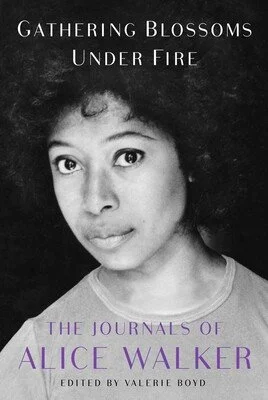
I recently read Alice Walker's Gathering Blossoms Under Fire, a collection of her journals from 1962-2000, and it is such a fascinating and intimate exploration. It's also an act of revolution: "While Walker was keeping these journals, virtually all published diarists were white."
I recently read Alice Walker's Gathering Blossoms Under Fire, a collection of her journals from 1962-2000, and it is such a fascinating and intimate exploration. It's also an act of revolution: "While Walker was keeping these journals, virtually all published diarists were white."
Some pages were tallies of her income and questions about being able to cover her expenses in her early years and then tallies and questions about real estate purchases in her later years. A sobering amount of pages were filled with the ups and downs of her romantic relationships. Some pages were about her writing life, her activism, her meditation practice, struggles with depression, her sexuality, and her garden.
The book is 500+ pages, and I was rapt! I kept thinking how brave she was to let her journals be published—most people want to keep their journals private and most authors would at least want to wait until they die before having them published. And the wild part was that at the beginning of her early journals and before all her recognition for A Color Purple she writes about having a sense that her journals would someday be published. I found this desire and ambition remarkable! And then she really didn't seem to hold back on what was included—it gets messy, as all lives do.
Walker's openness and passion for and trust in her desires is what made me want to keep reading entry after entry, and her faithful recordings of the details of life pointed toward the value she found in the supposed "mundane." I loved reading the thoughts of a woman who was writing, loving, and learning how to be at home with herself, and she's also a woman who prefers to have multiple homes, thank you very much!
Yes to it all,
Brianna

why the writing strategies never seem to last
I'm so excited because I re-read my poetry manuscript the other day and I liked it. This is a huge for a couple reasons. First, I didn't write for pleasure for years, so the fact that I have a manuscript is amazing. Now, when I want to write I usually do. Imagine that! And second, because the overall process has been light and playful, something I never thought possible.
I'm so excited because I re-read my poetry manuscript the other day and I liked it. This is a huge for a couple reasons. First, I didn't write for pleasure for years, so the fact that I have a manuscript is amazing. Now, when I want to write I usually do. Imagine that! And second, because the overall process has been light and playful, something I never thought possible.
I credit the foundation for this shift to one main thing: I started to actually like myself (which is probably why I like my manuscript). My baseline shifted from generally treating myself critically or with hostility to treating myself more and more with genuine care, trust, and friendliness.
I think this discussion is missing from a lot of the writing/art/creativity books and classes.
But it can be really helpful and feel so good to name why all the strategies and tools just don't seem to ever last or why setting your alarm a little earlier to make time for your writing isn't the key to everything. It's like you finally know what you're dealing with, which is where we must get to before we can really begin.
I love the poem “Distant Regard” by Tony Hoagland. It's about finding that place of self-friendliness, and it's from his final collection that he wrote shortly before he died, Priest Turned Therapist Treats Fear of God. (His book titles are all amazing.)
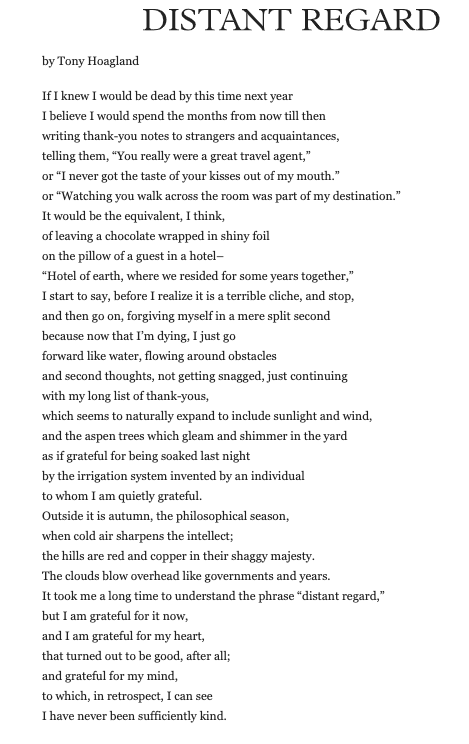
Yes to the idea of forgiving ourselves "like water, flowing around obstacles and second thoughts."
What do you think? Do you struggle with self-friendliness or self-kindness and do you think it's directly connected to any angst/tension you have with your writing/art/creativity? I'd love to hear.
Gratefully,
Brianna

wild puttering
I was recently trying to answer this question from a class I’m taking—what do you dream about or visualize when you imagine your future?
I closed my eyes and sat still and I had a faint vision of me puttering around a cozy home. Yep, that's it. And I was surprised, like really imagination, that’s the best you can come up with? It seemed like my dreams should be a bigger. Ha!
I was recently trying to answer this question from a class I’m taking—what do you dream about or visualize when you imagine your future?
I closed my eyes and sat still and I had a faint vision of me puttering around a cozy home. Yep, that's it. And I was surprised, like really imagination, that’s the best you can come up with? It seemed like my dreams should be a bigger. Ha!
I had a session with a spiritual director some years ago and I told her some of what I was grappling with as I was facing some big decisions in my life. She stood up and said she wanted to tell me something. And then she spread out her feet in a wide stance and put her hands on her hips and said: In the next ten years you are going to become a wild woman.
I couldn't see it then, but I loved that she could. She had a vision for my future, and in those intervening years, I remember borrowing from her vision, which perhaps is a very solid way to begin.
And what I've discovered over the years is that each person's version of "wild" looks different. My version of wild is less about big, bold adventures and more about the inner travels, and no version is right or wrong, just good to know.
For me, it's like this—let’s say there is a woman who moves from her bed to the kitchen table to the walk around her neighborhood to her desk to the kitchen table to the couch to her bed and her atmosphere is a calm pond around her and she lives behind her belly button. She is not constantly dispersed waves going out to her lover and child and the dying tree and the thing she said yesterday. She is contained within herself and she is present. She is making something. She is in fact smelling of almonds while the earth circles the sun.
Whew, she sounds like a wild woman, and like she enjoys puttering around a cozy home. :)
Gratefully,
Brianna
P.S. Wanna dream together? I'm here to help folks listen for and move toward their truest selves and truest dreams. And this kind of work is not about achieving and checking off individual goals. This is about trusting ourselves, and when we begin to trust and align with our own deep desires we can begin to take conscious responsibility for the life we've been given, which is a "mighty kindness" as Rumi says—it actually lightens the load of everything and everyone around us.